

What Is PD and Why Does It Matter?
Pupillary distance is the most overlooked measurement in eyewear — and possibly the most important. Get it wrong and even a perfect prescription will make you work harder than you should. Here's what it is, how it's measured, and why you should always know yours.
By Eddie Coyle Optometrists · Glasgow
The Measurement Nobody Talks About
Your glasses prescription is a set of optical instructions. But those instructions only work if the lens is positioned correctly in front of your eye. Pupillary distance — almost always abbreviated to PD — is the measurement that makes that possible. PD is simply the distance, in millimetres, between the centre of your right pupil and the centre of your left pupil. It determines where the optical centre of each lens is positioned within the frame. The optical centre is the point on a lens that provides the clearest, most distortion-free vision — and it needs to sit directly in front of your pupil.
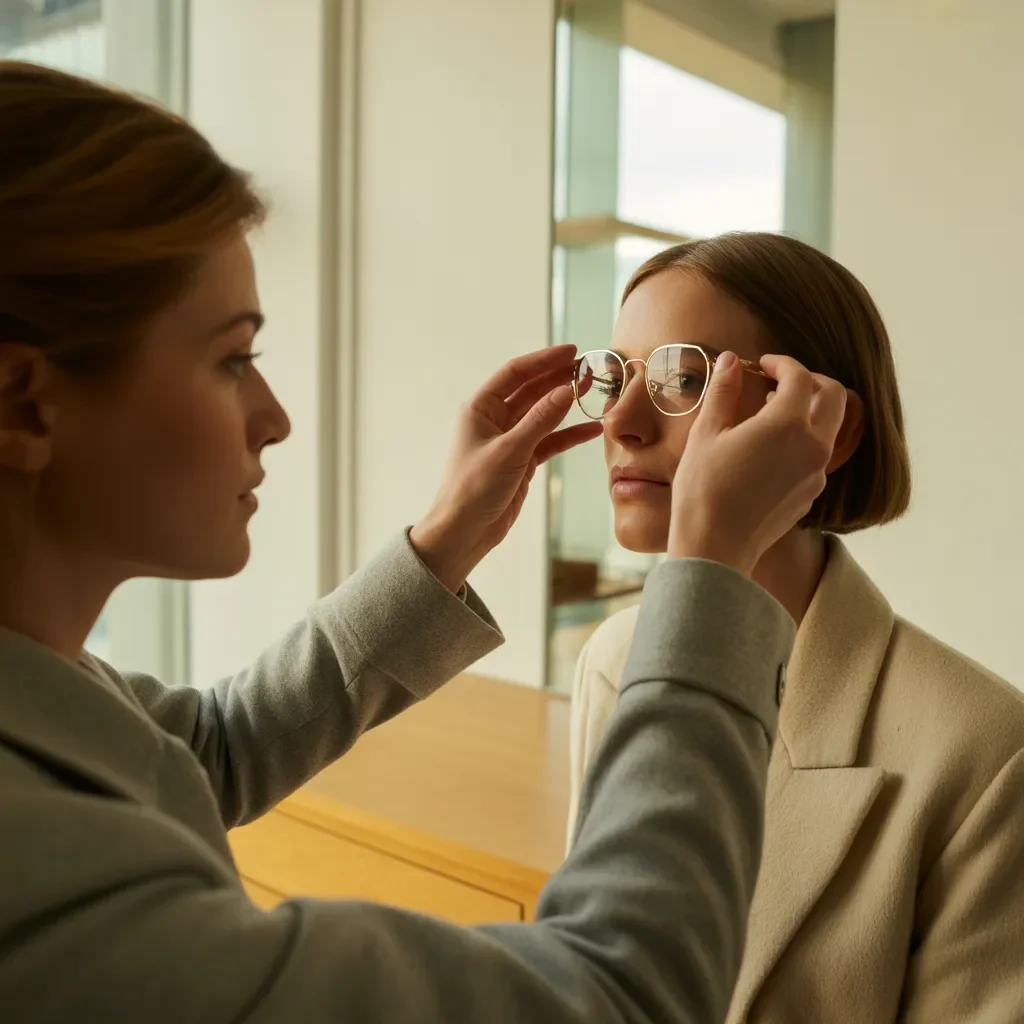
Frame size, pupillary distance and lens choice. Three variables, one goal — glasses that feel like they were made for you.
Single PD vs Dual PD
Your PD can be recorded as a single measurement (e.g., 64mm) representing the total distance across both eyes — or as two separate measurements representing each eye individually from the midpoint of the nose: e.g., 32/32mm or 33/31mm. Most faces are not perfectly symmetrical, which means the two halves of your PD are often slightly different. When ordering glasses online or using any premium online dispensing service, a dual (monocular) PD is always more accurate and always preferred.
“A lens with the optical centre 3mm off-centre is the equivalent of adding a prism to your glasses — one you never asked for.”
| Measurement | Value / Notes |
|---|---|
| Average adult PD | 60–68mm (typically 64mm) |
| Average child PD | 45–55mm (varies significantly with age) |
| Dual PD notation | Right eye / Left eye (e.g. 33/31) |
| Typical tolerance | ±1mm for distance · ±0.5mm for near/reading |
| Near vision PD | Subtract ~3mm from your distance PD (e.g. 64mm → approx. 61mm) |
What Happens If PD Is Wrong?
An incorrect PD introduces what optometrists call unwanted prism. Your eyes are sensitive instruments — when the optical centre of a lens doesn't align with your pupil, the brain has to work to compensate by rotating the eyes inward or outward. For lower prescriptions, a small PD error might go unnoticed. But as prescription strength increases, the effect becomes more significant. Common symptoms of an incorrect PD include: persistent headaches, eye strain after short periods of wear, a sense of pulling or discomfort behind the eyes, and difficulty adapting to new glasses. Many people who return new glasses reporting that they 'just don't feel right' are experiencing exactly this — and an incorrect PD is one of the first things a good dispensing optician will check.
Near Vision PD: A Separate Consideration
When you look at something close up — a book, a phone screen, a menu — your eyes naturally turn inward slightly, a movement called convergence. This means the effective PD for near tasks is smaller than for distance. For varifocal and bifocal lenses, this matters. Reading glasses typically use a PD approximately 3mm less than your distance PD (e.g., if your distance PD is 64mm, your near PD is approximately 61mm). Your optometrist will calculate this precisely when dispensing varifocals.
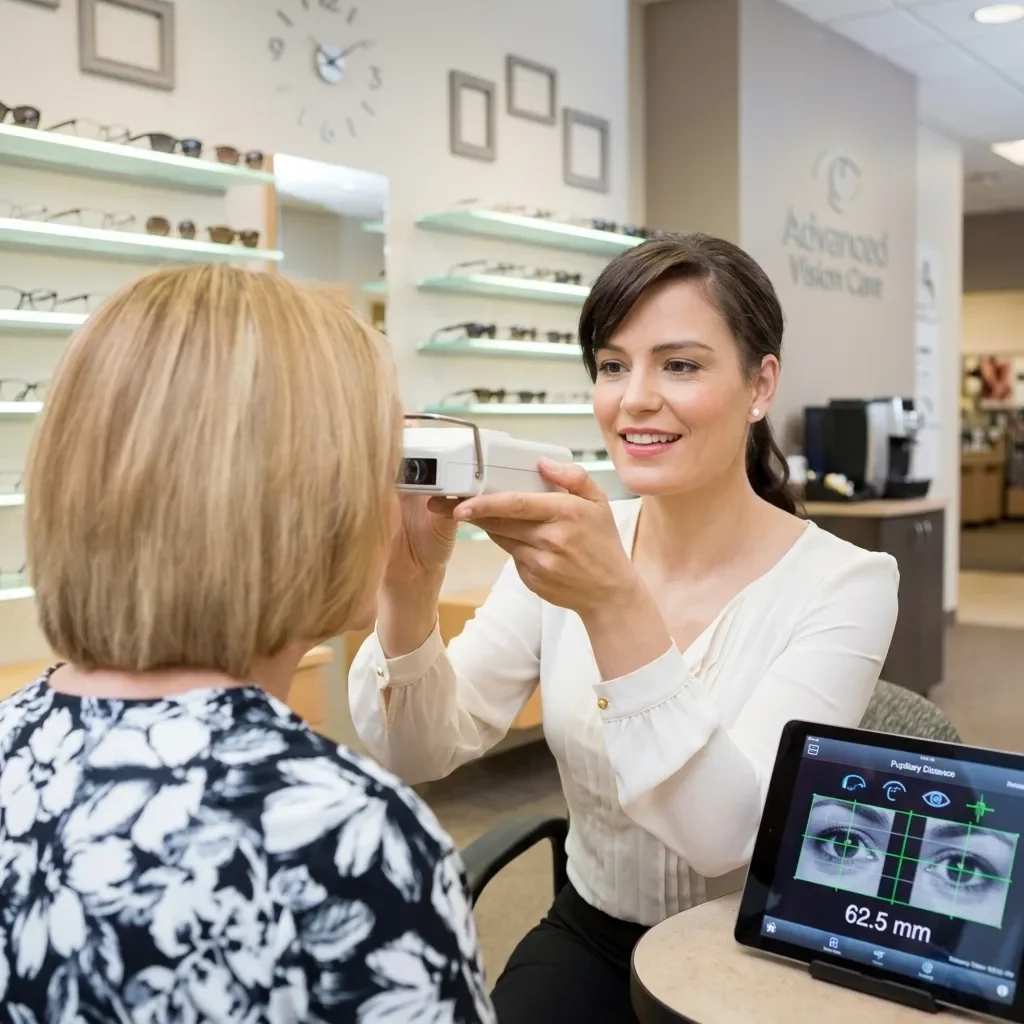
PD measurements: by hand with a ruler or using a pupillometer- both in expert hands.
Can You Measure Your Own PD?
In theory, yes — and there are apps and online tools that attempt this using your phone's front camera. In practice, self-measurement introduces errors that matter most when you can least afford them: higher prescriptions and varifocal lenses. The most reliable method is measurement by a qualified optometrist or dispensing optician using a pupillometer — a dedicated instrument designed for precisely this purpose.
At Eddie Coyle Optometrists, PD measurement is a standard part of our dispensing process and is taken at every new frame fitting.
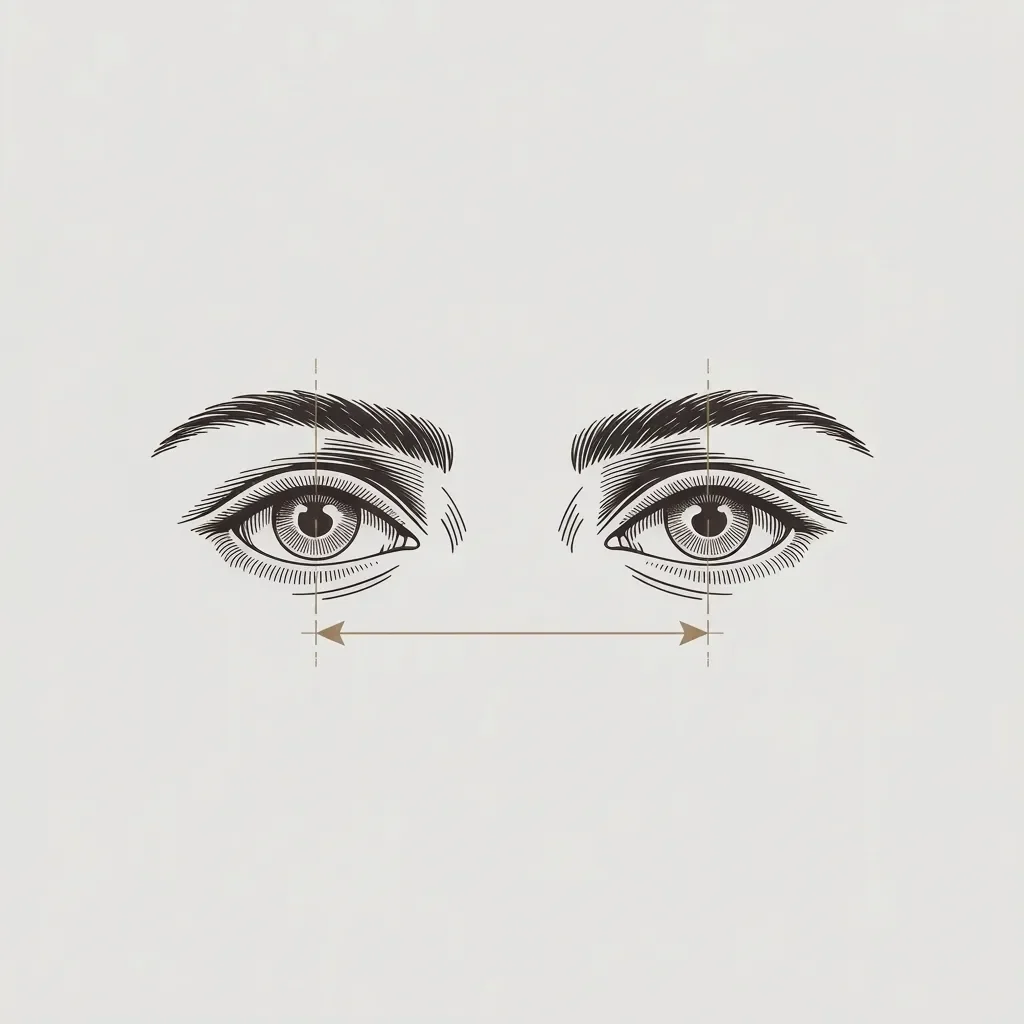
Measuring this distance looks easy but errors can easily be generated without correct technique.
PD and Online Eyewear: What You Should Know
The rise of online eyewear has made glasses more accessible and affordable — but it has also introduced a gap in the process. Many online retailers rely on customers providing their own PD, often self-measured or estimated. If you're ordering glasses online — whether from a budget retailer or a premium brand — always obtain your PD from your optometrist before you do. You have the right to request it. Some practices include it on your prescription; others may charge a small fee for the measurement if it was not taken as part of your examination. A correctly centred pair of lenses — even at a competitive online price point — will always outperform an incorrectly centred pair at any price. The PD is the foundation on which the rest of the dispensing process is built.
Need your PD measured?
Pop into either of our Glasgow practices — Dennistoun or Cambuslang. We're happy to measure your PD as part of any eye examination appointment, and we can advise on whether your current prescription is optimally centred in your existing glasses too.
Understanding Lens Index — Which Is Right for Your Prescription?
Thinner lenses, better optics, and how to avoid paying for more than you need.
Lens index explained in plain English.

The right lens depends on your prescription, your optometrist can guide you to the best option.
Why 'Thinner Lenses' Isn't Just About Aesthetics
When you're choosing new glasses, the conversation about lens index often starts with aesthetics —
nobody wants thick lenses. But lens index affects more than how your glasses look. It influences their
weight, their optical performance in certain conditions, how well they fit specific frame styles, and yes,
their cost. Understanding it gives you the information to make the right choice rather than simply
defaulting to 'the thinnest option available.'
What Is Lens Index?
Lens index — or refractive index — is a number that describes how efficiently a material bends light. The
higher the index, the more light-bending power a given thickness of material possesses. This means a
higher-index material can deliver the same optical correction in a thinner, lighter lens than a lower-index
one.
Standard plastic lenses (CR-39) have an index of 1.50. Mid-index lenses are typically 1.56 or 1.60.
High-index lenses are 1.67 or 1.74. Each step up produces a meaningfully thinner lens — but the
relationship isn't perfectly linear, and at the extremes, higher-index materials can introduce other optical
trade-offs.
Which Index Should You Choose?
The most honest answer is: the lowest index that looks and feels acceptable in your chosen frame. There's
no benefit — optical or aesthetic — in using a 1.74 lens when your prescription would be perfectly housed
in a 1.60. You pay more, and depending on the material, you may actually get slightly lower optical clarity
in the periphery.
As a general clinical guide, here's how to think about it:
Up to ±2.00D (Low prescription)
Standard 1.50 lenses are entirely appropriate. The edge thickness or centre thickness difference will be
minimal even in larger frames. Upgrading for aesthetics is perfectly reasonable, but not clinically
necessary.
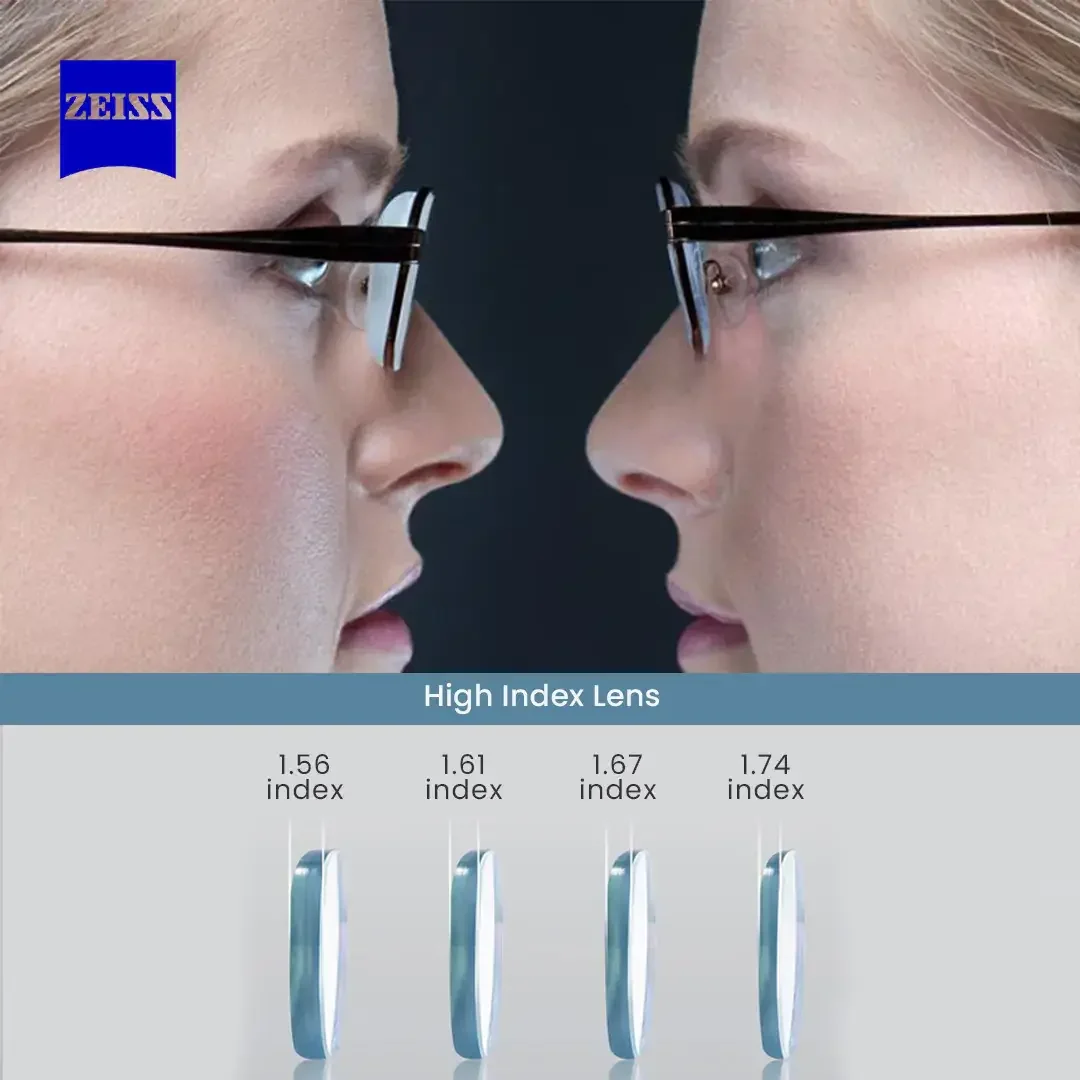
We have access to multiple lens suppliers allowing us to further optimise your lens choices.
±2.00D to ±4.00D (Moderate prescription)
This is where 1.60 index lenses start to make a meaningful difference, particularly in larger or rimless
frames. For myopes, edge thickness can become visible in wider frames at standard index. For hyperopes,
centre thickness becomes the concern. 1.60 offers a solid balance of visual performance and aesthetics at a
reasonable price.
±4.00D to ±6.00D (Higher prescription)
1.67 is typically the sweet spot here. The lens will be noticeably thinner and lighter than 1.60, which
becomes increasingly important as the prescription strengthens. Frame choice also becomes more critical
— smaller frames with a well-centred lens will always look better than a large frame in any index.
Above ±6.00D (Strong prescription)
1.74 is worth considering seriously here — particularly for myopes, where the edge thickness of a
high-minus lens can be dramatic in lower-index materials. Your dispensing optician can calculate the
predicted edge and centre thickness in different indices before you commit, which we always recommend
at this prescription level.
“Frame choice and lens centration do more for the appearanceof a strong prescription
than lens index alone — but the right index makes both work better.”
Astigmatism and Lens Index
If you have a significant cylinder correction, the lens index calculation is slightly more complex. Cylinder
lenses have different power in different meridians, which affects thickness at multiple points around the
lens edge. High-cylinder prescriptions often benefit from 1.60 or 1.67 index even at more moderate sphere
values — it's worth discussing with your optician.
Lens Coatings: The Layer on Top of Index
Lens index affects the base material — but the coatings applied to it are equally important and often more
impactful on everyday visual experience. Anti-reflection (AR) coating is arguably the most important
upgrade you can make regardless of index: it reduces glare from screens, streetlights, and oncoming
headlights, and makes your lenses look cleaner.
At Eddie Coyle Optometrists, we work with Zeiss and Hoya lenses — suppliers whose coating technology
is among the best available. Their premium AR coatings include oleophobic (smudge-resistant) and
hydrophobic layers that extend the practical life of the lens significantly. Cutting costs on coatings while
spending heavily on index is rarely the right trade-off.
The Abbe Value: The Trade-Off Nobody Mentions
Here's the thing the lens industry doesn't always shout about: higher-index materials generally have a
lower Abbe value. The Abbe value measures chromatic aberration — the tendency of a lens to split white
light into its colour components at the periphery of the lens, causing slight colour fringing in low and
peripheral vision.

Higher index lenses have more aberrations and so are supplied with hi tech coatings to counteract glare.
Standard 1.50 CR-39 has an Abbe value of around 58 — among the best of any ophthalmic material. 1.74
drops to around 33. For most people in most situations, this is not a noticeable problem. But for those with
sensitive vision, for driving lenses, or for patients who have previously found high-index lenses
uncomfortable, it's worth knowing that optical purity and physical thinness exist in mild tension.
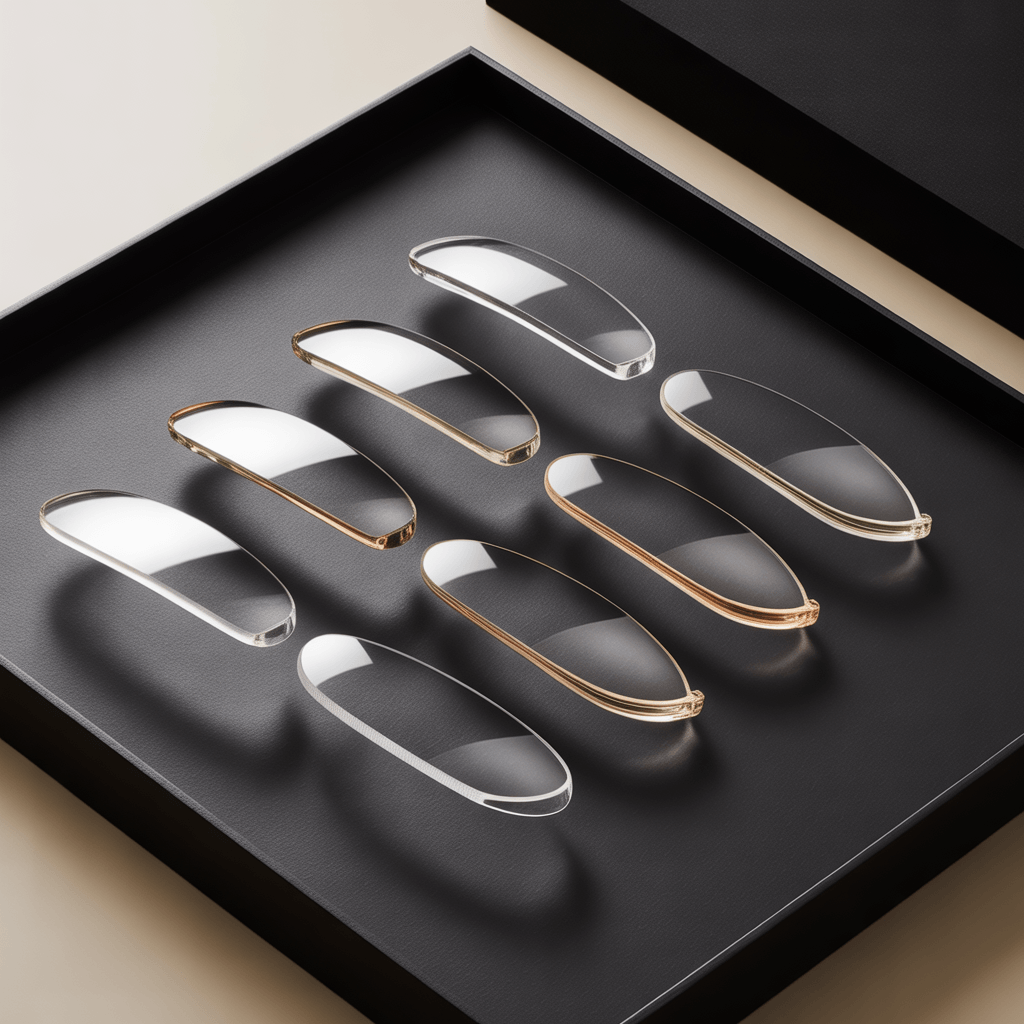
Every prescription is unique and each lens should be tailored to that individual and coupled with the frame choice.
Not sure which index is right for your prescription? Bring your prescription slip into our Dennistoun or
Cambuslang practice and we'll calculate exactly how each index option would look in your chosen frame
including predicted edge thickness before you make a decision. No pressure, no jargon.
Top 5 Eyewear Trends for 2024
Our top 5 eyewear trends for 2024 – let's dive in.
Navigating the dynamic world of eyewear can seem daunting as new trends continuously emerge. Eyewear trends mirror the styles of our era, and 2024 is shaping up to be quite interesting.
From sporty chic to eco-conscious options, delving into the latest eyewear trends is an exhilarating journey.
A myriad of noteworthy brands, such as the iconic Paul Smith, the Italian powerhouse Gucci, and the Danish lightweight marvel Lindberg to name but a few all propelling innovation at an intriguing pace.
Top Trends for 2024
1. Athleisure Eyewear: Style Meets Practical
The resurgence of wraparound shades a major 90's trend, more recently exclusive to athletes, looks like making a strong comeback in 2024.
Embraced by Gen Z and showcased in fashion shows, these frames cater to the on-the-go lifestyle.
Complete the look with smart glasses combining these shapes with photoreactive lenses, beyond a fashion statement, brands like Gucci combine functionality with a high-tech edge, offering photochromic lenses that blend style and adaptability.

Gucci 1429 S 001 a throwback to a familiar 90s icon, as seen on Travis Scott and Kim Kardashian.
2. Gradient frames gain prominence in 2024, offering a contemporary and subtly artistic approach to eyewear design.
Transitioning hues create a mesmerizing effect, injecting flair and vibrancy into any outfit. While these frames might feel daring to those accustomed to safer color choices, with the right styling, they can become a go-to accessory.
Choosing complementary gradient colors, akin to an artist selecting hues for a canvas, ensures your eyewear resonates or complements your outfit's tones.

Paul Smith exemplify sartorial elegance with this contemporary style, a fantastic example of colour gradients.
3. Bold and Functional.
A fascination with shield sunglasses has emerged in 2024, originating from sports but later captivating the fashion scene.
Similar to the wrap concept where style follows function but rooted in the flamboyant 1970s, these frames feature an iconic wraparound design resulting from advancements in lens technology.
Characterized by expansive lens areas, Shield frames make a dominant fashion statement while providing enhanced protection.

Gucci1631S
Stand out with this fashion forward shield style from Gucci as worn by Lisa Rinna.
4. Oversized Square Frames A strong trend from 2023 continues into 2024 embracing maximalism in eyewear, with oversized square frames taking center stage.
Ideal for making a bold statement, these frames complement various face shapes, ensuring both form and function are in perfect harmony.
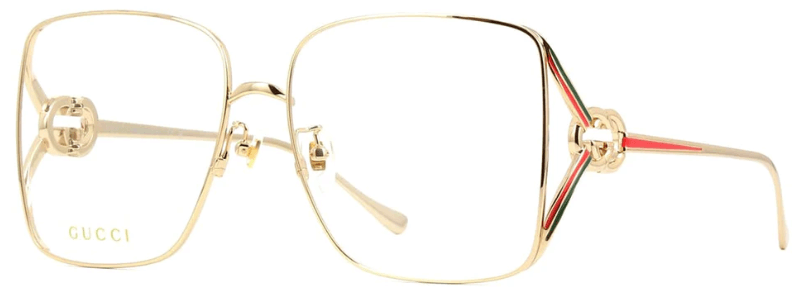
GG1321O big bold and beautiful this ovesized square frame is a timeless classic that is never out of fashion and is going to be big in 2024 in more ways than one.
5. The trend for crystal frames continues but with a twist of colour to soften the look.
The eyewear landscape now embraces a rainbow of colours, from Paul Smith’s champagne to Gucci's subtle coral lenses.
Transparent frames, low key yet stylish clear frames embody elegance in simplicity, claiming the spotlight in 2024.
Evident in a rising interest noted by eyewear specialists, clear frames gracefully adapt to all skin tones through cold and warm tints. Perfect for accentuating facial features or makeup without overshadowing, these frames come in various styles, offering adaptability and style.

Paul Smith maintain the transparent aesthetic but add a touch of sophistication with this light grey and amber tint making the frame a better fit for cooler skin tones than a clear crystal.
Make an appointment today to have a frame style consultation at one of our stores where we will be delighted to help you find the perfect style to complete your look. Our optometrist will be happy to advise on how to pair the perfect lens choices with your frames to give the best possible finish and maintain clear and comfortable vision.

First Blog Post
We are delighted with the fit out of our new practice in Dennistoun.
Hats off to Coco Zheng for the fantastic concept, design and project management!
Introducing Eddie Coyle Optometrists’ Blog!
We’re thrilled to announce the launch of our blog with our inaugual post.
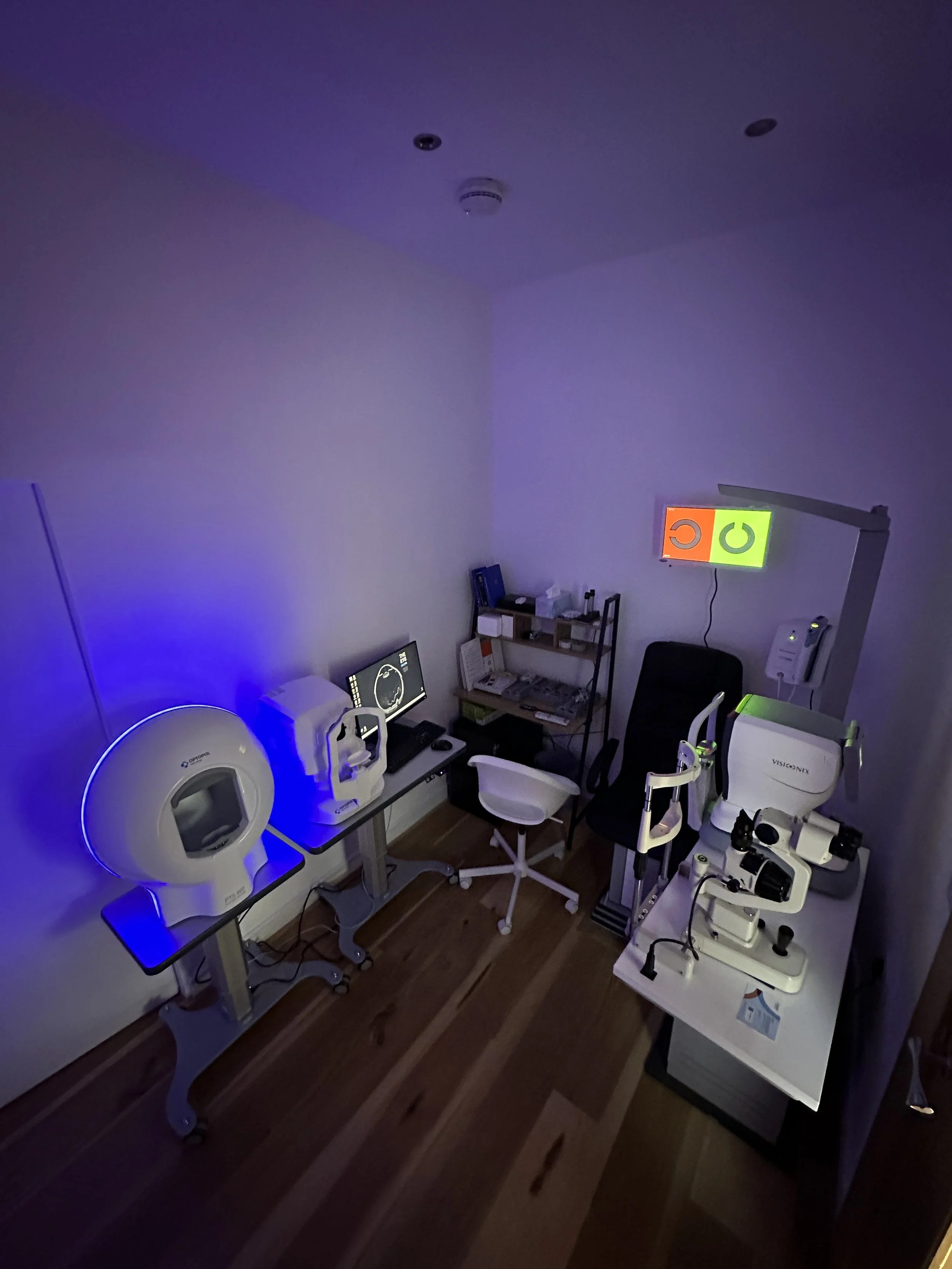
We are also proud to announce the opening of our new practice in Dennistoun, our new shop at 427a Alexandra Parade is ready to redefine your eye care experience.
Kudos to Coco Zheng for the amazing concept and execution of the shop fit.

Alexandra Parade practice
Our new practice in Dennistoun is bright and contemporary providing an exemplary retail therapy experience.
This blog offers you a go-to source for the latest in Optometry and updates within our business.
Stay informed with insightful articles on advancements in Optometry, expert advice on eye health, and exclusive peeks into the world of Eddie Coyle Optometrists.
This blog is more than just updates; it’s a bridge connecting you to the evolving landscape of eye care. Join us on this journey of optical exploration, as we share valuable insights, exciting developments, and everything you need to know about keeping your vision at its best.




Your eyesight matters, and so does being in the know – welcome to the Eddie Coyle Optometrists community!