Understanding Lens Index — Which Is Right for Your Prescription?
Thinner lenses, better optics, and how to avoid paying for more than you need.
Lens index explained in plain English.

The right lens depends on your prescription, your optometrist can guide you to the best option.
Why 'Thinner Lenses' Isn't Just About Aesthetics
When you're choosing new glasses, the conversation about lens index often starts with aesthetics —
nobody wants thick lenses. But lens index affects more than how your glasses look. It influences their
weight, their optical performance in certain conditions, how well they fit specific frame styles, and yes,
their cost. Understanding it gives you the information to make the right choice rather than simply
defaulting to 'the thinnest option available.'
What Is Lens Index?
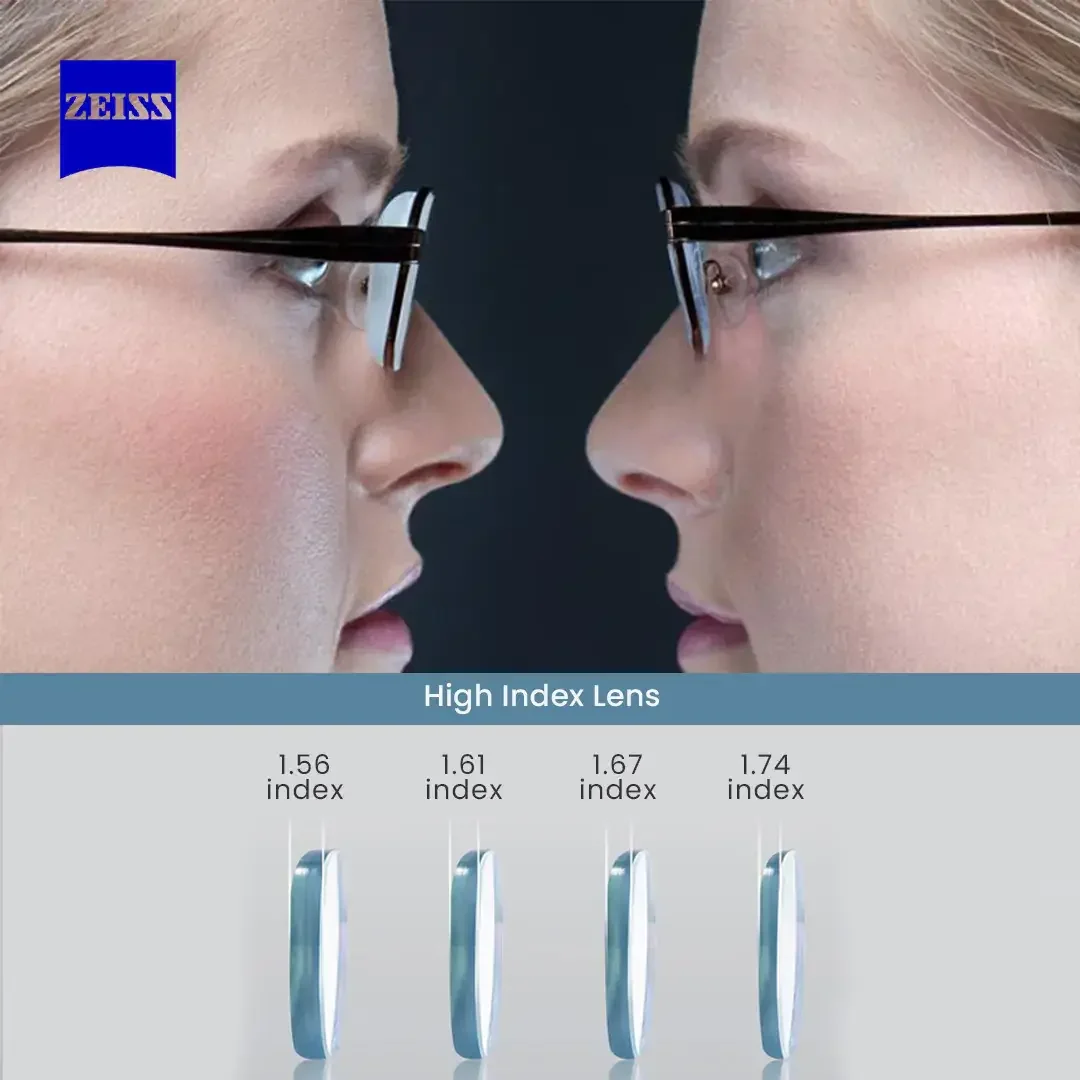
Lens index — or refractive index — is a number that describes how efficiently a material bends light. The
higher the index, the more light-bending power a given thickness of material possesses. This means a
higher-index material can deliver the same optical correction in a thinner, lighter lens than a lower-index
one.
Standard plastic lenses (CR-39) have an index of 1.50. Mid-index lenses are typically 1.56 or 1.60.
High-index lenses are 1.67 or 1.74. Each step up produces a meaningfully thinner lens — but the
relationship isn't perfectly linear, and at the extremes, higher-index materials can introduce other optical
trade-offs.
Which Index Should You Choose?
The most honest answer is: the lowest index that looks and feels acceptable in your chosen frame. There's
no benefit — optical or aesthetic — in using a 1.74 lens when your prescription would be perfectly housed
in a 1.60. You pay more, and depending on the material, you may actually get slightly lower optical clarity
in the periphery.
As a general clinical guide, here's how to think about it:
Up to ±2.00D (Low prescription)
Standard 1.50 lenses are entirely appropriate. The edge thickness or centre thickness difference will be
minimal even in larger frames. Upgrading for aesthetics is perfectly reasonable, but not clinically
necessary.
We have access to multiple lens suppliers allowing us to further optimise your lens choices.
±2.00D to ±4.00D (Moderate prescription)
This is where 1.60 index lenses start to make a meaningful difference, particularly in larger or rimless
frames. For myopes, edge thickness can become visible in wider frames at standard index. For hyperopes,
centre thickness becomes the concern. 1.60 offers a solid balance of visual performance and aesthetics at a
reasonable price.
±4.00D to ±6.00D (Higher prescription)
1.67 is typically the sweet spot here. The lens will be noticeably thinner and lighter than 1.60, which
becomes increasingly important as the prescription strengthens. Frame choice also becomes more critical
— smaller frames with a well-centred lens will always look better than a large frame in any index.
Above ±6.00D (Strong prescription)
1.74 is worth considering seriously here — particularly for myopes, where the edge thickness of a
high-minus lens can be dramatic in lower-index materials. Your dispensing optician can calculate the
predicted edge and centre thickness in different indices before you commit, which we always recommend
at this prescription level.
“Frame choice and lens centration do more for the appearanceof a strong prescription
than lens index alone — but the right index makes both work better.”
Astigmatism and Lens Index
If you have a significant cylinder correction, the lens index calculation is slightly more complex. Cylinder
lenses have different power in different meridians, which affects thickness at multiple points around the
lens edge. High-cylinder prescriptions often benefit from 1.60 or 1.67 index even at more moderate sphere
values — it's worth discussing with your optician.
Lens Coatings: The Layer on Top of Index
Lens index affects the base material — but the coatings applied to it are equally important and often more
impactful on everyday visual experience. Anti-reflection (AR) coating is arguably the most important
upgrade you can make regardless of index: it reduces glare from screens, streetlights, and oncoming
headlights, and makes your lenses look cleaner.
At Eddie Coyle Optometrists, we work with Zeiss and Hoya lenses — suppliers whose coating technology
is among the best available. Their premium AR coatings include oleophobic (smudge-resistant) and
hydrophobic layers that extend the practical life of the lens significantly. Cutting costs on coatings while
spending heavily on index is rarely the right trade-off.
The Abbe Value: The Trade-Off Nobody Mentions
Here's the thing the lens industry doesn't always shout about: higher-index materials generally have a
lower Abbe value. The Abbe value measures chromatic aberration — the tendency of a lens to split white
light into its colour components at the periphery of the lens, causing slight colour fringing in low and
peripheral vision.

Higher index lenses have more aberrations and so are supplied with hi tech coatings to counteract glare.
Standard 1.50 CR-39 has an Abbe value of around 58 — among the best of any ophthalmic material. 1.74
drops to around 33. For most people in most situations, this is not a noticeable problem. But for those with
sensitive vision, for driving lenses, or for patients who have previously found high-index lenses
uncomfortable, it's worth knowing that optical purity and physical thinness exist in mild tension.
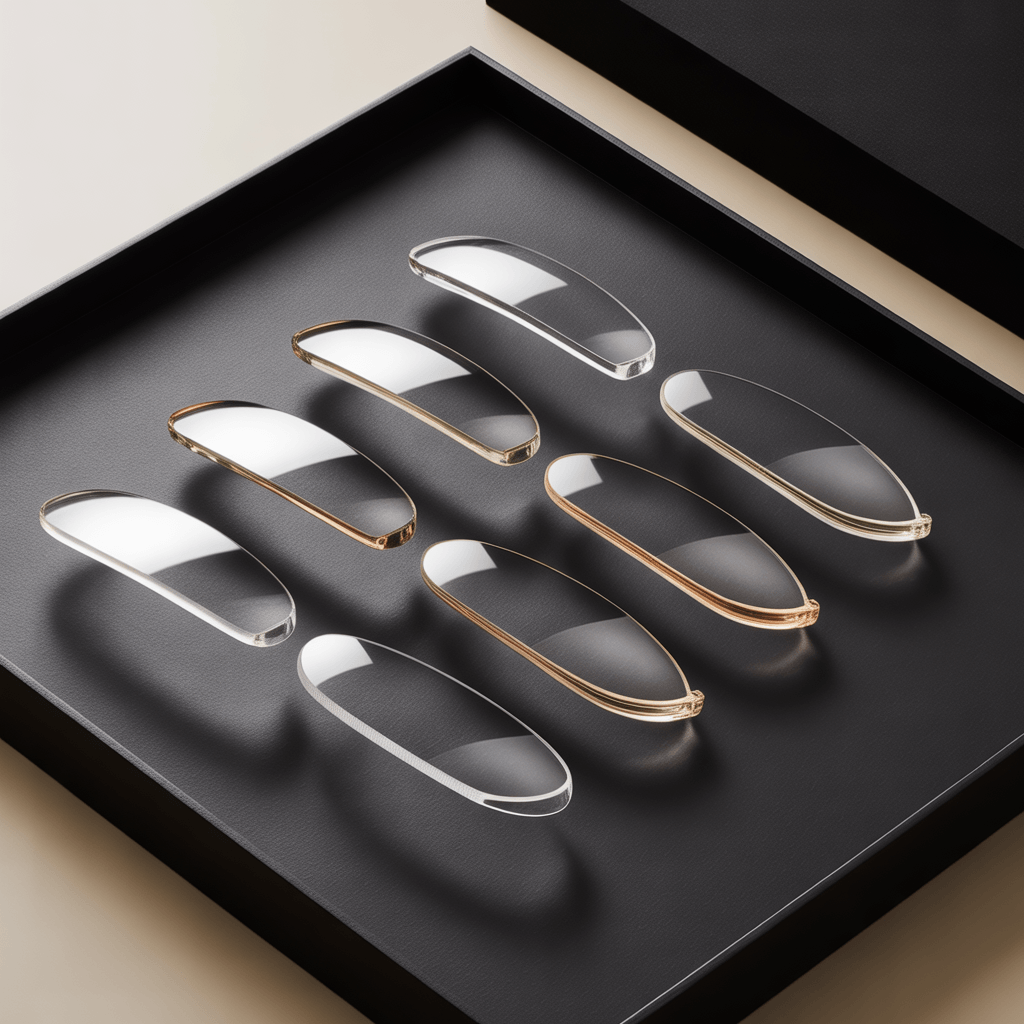
Every prescription is unique and each lens should be tailored to that individual and coupled with the frame choice.
Not sure which index is right for your prescription? Bring your prescription slip into our Dennistoun or
Cambuslang practice and we'll calculate exactly how each index option would look in your chosen frame
including predicted edge thickness before you make a decision. No pressure, no jargon.