
Why Online Glasses Go Wrong — An Optometrist Explains
By Eddie Coyle, GOC-registered optometrist
Let's start with an uncomfortable truth online prescription glasses often work fine. For a significant portion of wearers, low prescriptions, simple single-vision lenses, frames that happen to sit well on their face, the experience is perfectly acceptable.
The price is lower. The convenience is real. I'm not going to pretend otherwise.
But "often fine" and "reliably correct" are different things. And when online glasses go wrong, they go wrong in ways that are genuinely hard to diagnose without clinical training. Wearers frequently blame themselves, assume they need time to adjust, that their eyes are tired, that maybe they need a new prescription. In many cases, the problem isn't the prescription at all.
This is what actually goes wrong, and why.
The five real failure points
Pupillary distance measured badly
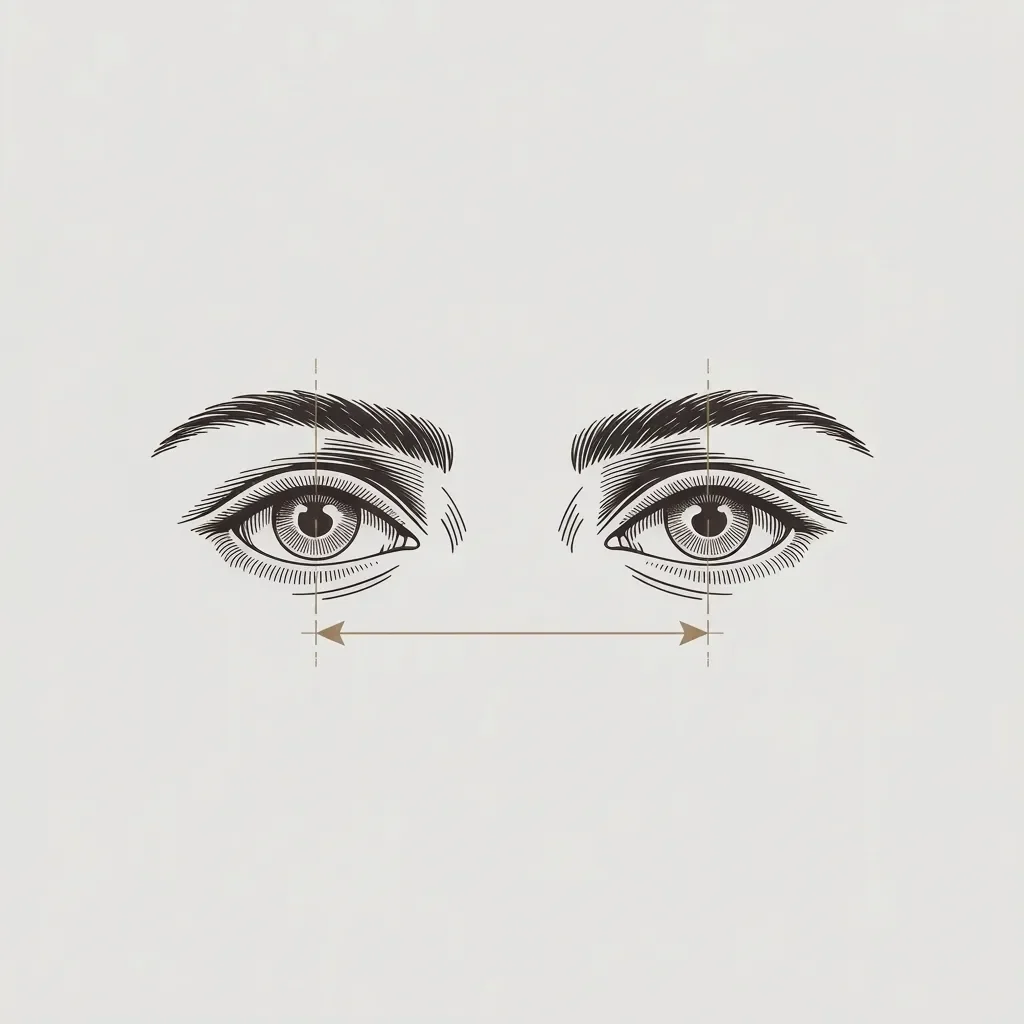
Your pupillary distance (PD) is the measurement from the centre of one pupil to the centre of the other. It determines where on each lens your eye actually looks through. Get it wrong by 2–3mm and the optical centres of your lenses are sitting in the wrong place. For low prescriptions, most people adapt. For anything above ±3.00D, or for anyone with astigmatism, even a small PD error creates prismatic imbalance — your eyes are constantly working to compensate for a lens that's pulling them slightly in the wrong direction. The symptom is usually headaches, eye strain, or a vague feeling that something is off. It's almost never attributed to PD measurement error by the wearer.
Centration in the frame — a different problem entirely
PD is only one half of the centration equation. The other is fitting height , where the optical centre of the lens sits vertically within the frame. This is specific to the frame you're ordering, the position it sits on your face, and your prescription type. For varifocals, centration errors are catastrophic — the progressive corridor is in the wrong position entirely. For single-vision lenses, it matters more than most people realise. Online ordering rarely captures this because it requires someone to actually mark the lens position on a frame sitting on your face.
Vertex distance — close enough rarely is
Vertex distance is the gap between the back of the lens and the front of your eye. Your prescription is written for a standard vertex distance. As prescriptions increase in power, even small changes in vertex distance change the effective power of the lens reaching your eye. A frame that sits slightly further from your face than the test frame used during your eye examination can mean you're effectively wearing a slightly different prescription. Most people never know. Their brain compensates partially and they live with marginally suboptimal vision.
No clinical override
An experienced optometrist or dispensing optician will sometimes modify what they dispense. A prescription that tests well in the chair doesn't always translate directly into a wearable lens, particularly for first-time varifocal wearers, significant prescription changes, or complex astigmatism corrections. There's clinical judgement involved in adapting the prescription to the patient and the frame. Online, there is no such filter. The numbers go in; the glasses come out.
Frame geometry you can't evaluate from a screen
Wrap angle, pantoscopic tilt, frame width relative to face width, these aren't aesthetic considerations. They directly affect how the lens performs. A frame that wraps further around the face than the standard dispense position changes the effective axis of an astigmatic correction. You can't evaluate this from a product image.
The PD problem in detail, and how to handle it
This is worth its own section because measuring your own PD is simultaneously the most important thing you need to get right when ordering online, and one of the more awkward practical tasks you'll ever undertake in your bathroom.
The ruler method (with a friend)
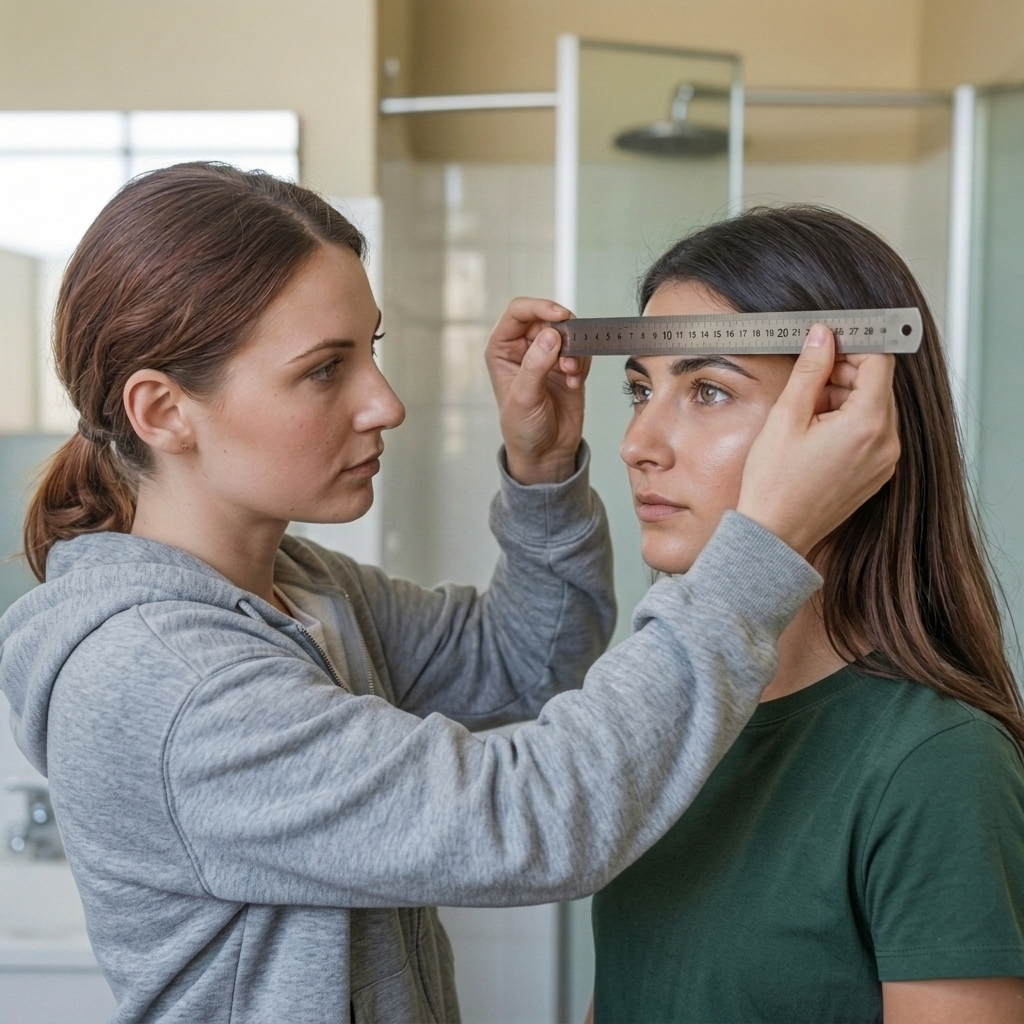
The gold standard DIY approach: stand in front of a mirror, have a friend hold a millimetre ruler flat across your nose, and measure from pupil to pupil while looking straight ahead. Simple in theory. In practice: the person measuring tends to move, you tend to look at them rather than the mirror, the ruler doesn't stay level, and neither of you is entirely sure exactly where "the centre of the pupil" is when you're looking at a slightly squinting face from six inches away. It helps to measure three times and average the result. It also helps if your friend is calm, has good close-up vision, and doesn't mind you standing slightly too close to them for longer than feels normal.

Solo mirror method
Hold the ruler yourself, look straight into the mirror (not at the ruler), and measure. This requires either very good peripheral vision, a photograph, or significant trial and error. Most people end up slightly cross-eyed trying to read the measurement at the same time as maintaining straight-ahead gaze. The results are variable.

PD measurement apps
Several apps now offer PD measurement using your phone's front camera — and when they work, they're genuinely useful. The accuracy varies considerably depending on your phone model, lighting, and how still you can hold your head. Some require a standard card held against your face for calibration. The better ones (we use one at Luxforde) are reasonably accurate for straightforward single-vision prescriptions. Where they tend to struggle: darker skin tones where pupil contrast against the iris is lower, very dark eyes, and any situation where the lighting is uneven or the camera angle is slightly off. Not unusable — but worth treating with appropriate scepticism for higher prescriptions.
More creative approaches people actually try
Some people photograph themselves with a ruler held at forehead level (surprisingly reasonable if the photo is square-on and well-lit). Some use their old glasses as a reference — placing them flat on a ruler and measuring the distance between the optical centres, which are sometimes marked by a faint dot or cross on the lens. A few people hold a ruler in their teeth. One patient of mine measured using a playing card as a fixed reference and worked it out geometrically. I can neither confirm nor deny whether this worked.
When to stop and ask your optometrist
If your prescription is above ±3.00D sphere, has significant astigmatism (cylinder above 1.50D), or you're ordering varifocals — don't struggle with home measurement. The consequences of a 2mm error are too significant and too uncomfortable to justify the saving.
The awkward part: asking your optometrist for your PD, particularly if you've recently had an eye test elsewhere and you're clearly not buying glasses there. Most practices will provide the measurement if asked, though some may charge a small fee (typically £5–£15) since it does require a member of staff and a few minutes of time. That's entirely reasonable. It's also worth asking at the time of your eye test — "Can I have my PD as well?" — before anyone realises you're considering buying elsewhere. This is not a deceptive move. It's your clinical information. You're entitled to it.
What this means in practice
None of this is an argument against ever buying glasses online. It's an argument for understanding exactly what you're taking on when you do.
For a simple prescription under ±2.00D with no significant astigmatism, a reasonable PD measurement, and a frame that doesn't require precise fitting? Online dispensing is a defensible choice and the savings are real.
For anything more complex higher powers, varifocals, significant astigmatism, post-surgical eyes, or anyone who has previously struggled to adapt to new glasses the failure risk is high enough that the saving starts to look less compelling. The clinical overhead exists for a reason.
The best online optical models acknowledge this. They build in clinical touchpoints where the prescription complexity warrants it, rather than treating every order as identical input to a production process. That's not the current norm. It should be.
Eddie Coyle is a GOC-registered optometrist and the founder of Luxforde Eyewear a direct-to-consumer prescription eyewear brand built around clinical dispensing accuracy.