
How to Choose a Frame for Your Face Shape — The Honest Guide
Most face shape guides tell you oval faces suit everything and leave it at that. Here's a more useful version — one that accounts for how glasses actually sit on a real face.
Why Most Face Shape Guides Fall Short
The standard advice you'll find online sorts faces into four or five geometric categories — oval, round, square, heart — and assigns a frame shape to each. It's tidy, it's repeatable, and it's largely useless in practice.
Real faces don't sort cleanly into categories. More importantly, frame choice isn't just about face shape. It's about where your features sit, how prominent they are, what your colouring is, and what the glasses need to do — whether that's correct a strong prescription, accommodate a wide pupillary distance, or simply work with how you dress. A frame that looks right on a model with your approximate face shape may look completely wrong on you, for reasons that have nothing to do with geometry.
This guide won't tell you what shape you are. It will give you a framework for thinking about what actually works — and what to look for when you're in front of a mirror.
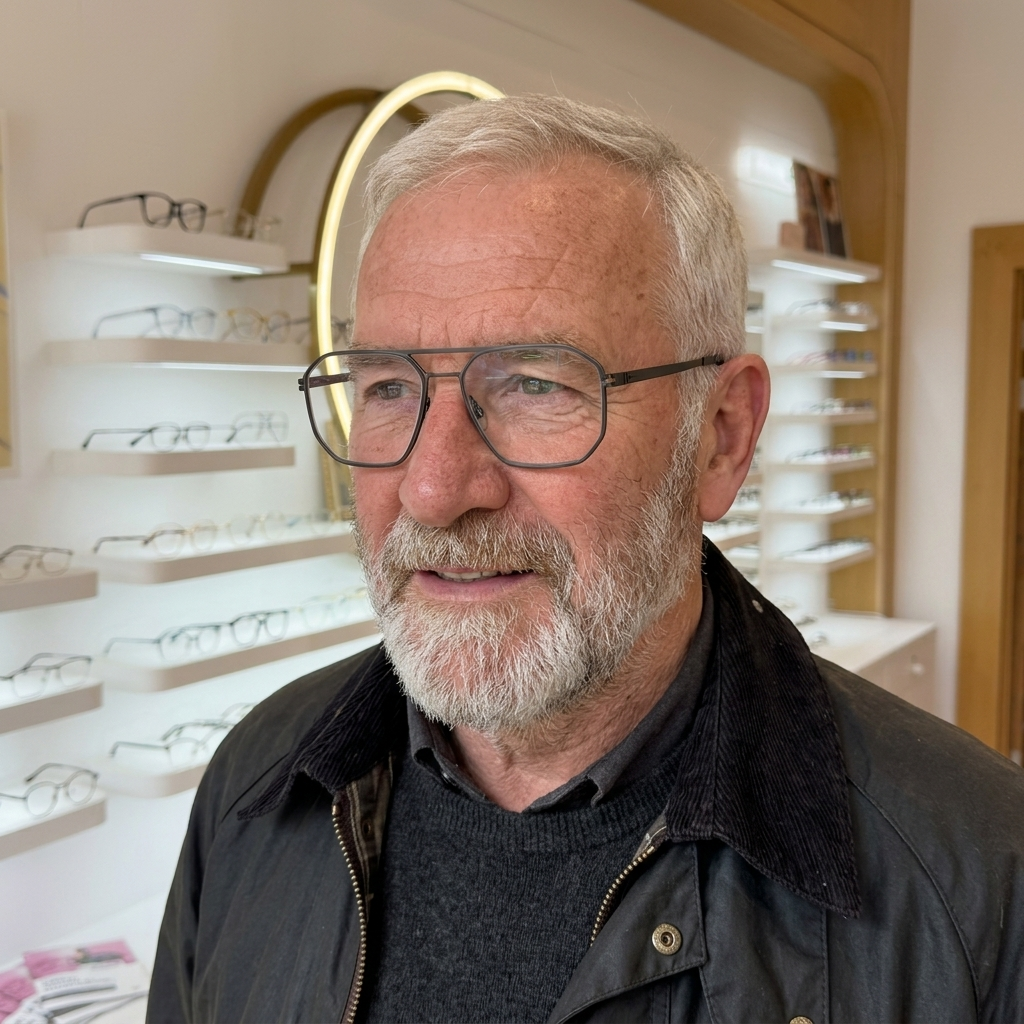
Going by the book
Classic aviator on a mature male face with angular features. The frame suits him perfectly, proportions are right, colour is neutral. There's nothing wrong with it, but it's exactly what a face shape guide would recommend.
Start With Proportion, Not Shape
The most useful single principle in frame selection is contrast and balance. Glasses that work tend to contrast with the dominant lines of your face rather than repeat them.
If your face has strong angular features — a defined jaw, sharp cheekbones, a wide forehead — a frame with some curve softens the overall impression. If your face is naturally soft and rounded, a frame with some structure and straight lines adds definition.
This isn't a rigid rule. But it's a more reliable starting point than trying to identify whether your jawline is "square" or "oblong."
Key proportions to consider
The frame width should broadly match your face width at the temples. A frame that sits significantly narrower than your face will look pinched; one that's much wider will overpower your features. This is one area where an actual fitting — rather than ordering online — makes a real difference. We can see immediately whether a frame sits correctly or fights your face.
The depth of the frame (the vertical measurement) affects how much of your face the glasses occupy. A deeper frame draws more attention to the glasses themselves; a shallower one is more discreet. Neither is wrong, but it's worth being deliberate about which effect you want.
The Features That Matter More Than Face Shape
Nose bridge The fit of the bridge is the single most important factor in whether glasses are comfortable long-term. A bridge that sits too high or too low will shift the optical centre of the lens away from your pupil — the same problem as an incorrect PD, with similar consequences for visual comfort. Beyond comfort, the bridge position affects how the glasses appear on your face. A higher bridge tends to make the nose appear shorter; a lower one has the opposite effect. Adjustable nose pads offer more flexibility than fixed saddle bridges, particularly for flatter nose profiles.
Brow line The top of the frame should ideally sit close to — or just below — your natural brow line. A frame that sits significantly above the brow creates an awkward gap; one that covers the brow entirely tends to look heavy and mask the face. Browline frames — with a thicker upper rim and minimal lower rim — work well precisely because they echo the natural brow, adding definition without concealing it.
Eye position within the frame Your pupil should sit roughly in the centre of the lens, both horizontally and vertically. If your eye sits too close to the top or bottom of the frame, or off to one side, the lens proportions aren't right for your face. This is something an experienced dispensing optician will assess at fitting — it's not something you can reliably judge from a photograph or an online try-on tool.
Prescription and Frame Choice: The Practical Constraints
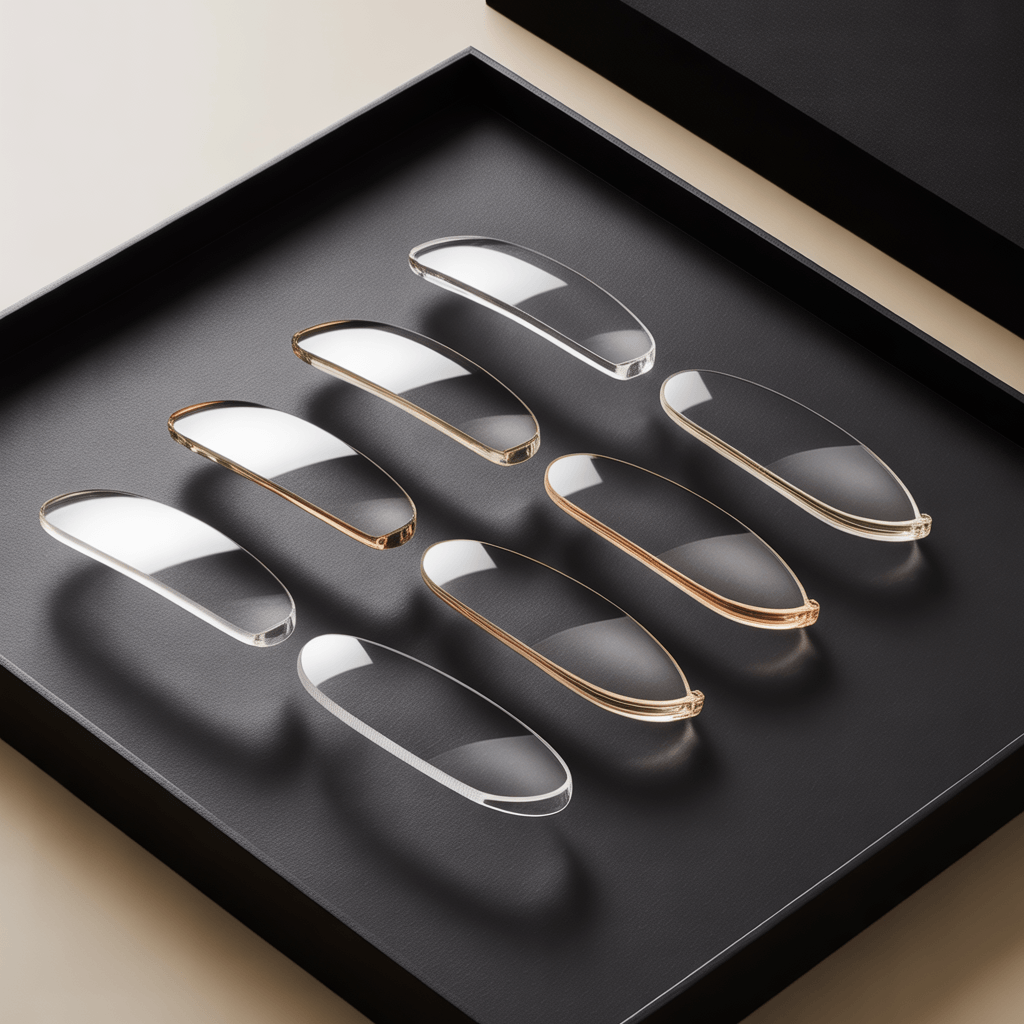
Start with lenses.
For moderate to strong prescriptions, frame choice isn't just aesthetic — it has a direct effect on how your lenses look and how well they perform.
Lens thickness and frame size For higher minus (myopic) prescriptions, the edges of the lens are thicker than the centre. A larger frame means more lens area, which means more visible edge thickness. Smaller frames — particularly those with a well-centred fit — will always produce a better aesthetic result in a strong prescription than a large fashion frame in the same index material. This is something we calculate at the point of dispensing: we can show you the predicted edge thickness in different frame sizes before you commit.
Strong prescriptions and frame style Full-rim frames conceal the lens edge entirely and are almost always the better choice for stronger prescriptions. Semi-rimless and rimless styles expose the lens edge, which becomes increasingly conspicuous as prescription strength increases. If you love the aesthetic of a rimless frame but have a significant prescription, it's worth having an honest conversation with your optician about the trade-offs before you order.
Astigmatism and lens rotation For significant cylinder corrections, lens orientation within the frame is critical. Rimless and drill-mounted frames offer less structural support, which can allow lenses to rotate slightly over time — enough to affect vision. Full-rim frames hold the lens more securely in its correct orientation.
Colour and Material
Frame colour and skin tone Warm skin tones — yellow, olive, or peachy undertones — tend to be complemented by warmer frame colours: tortoiseshell, gold, warm browns, olive greens. Cooler skin tones — pink or bluish undertones — suit cooler frames: silver, black, grey, cool blues and purples. This isn't absolute, and contrast can be used deliberately — a strong black frame on a warm complexion makes a statement rather than a mistake. But it's a useful starting framework when you're unsure.
Hair and eye colour Frames that pick up a colour present elsewhere in your appearance — a shade in your hair, or a complementary to your eye colour — tend to look more considered than purely contrasting choices. Again, this is a starting point, not a rule.
Material Acetate frames offer the widest range of colour and pattern, hold their shape well, and feel substantial on the face. Metal frames are lighter and more minimal, with a more precise, engineered aesthetic. Titanium sits at the premium end of metal — exceptionally light, hypoallergenic, and durable. If you've had issues with frame weight or skin sensitivity previously, it's worth discussing material as part of the selection process.
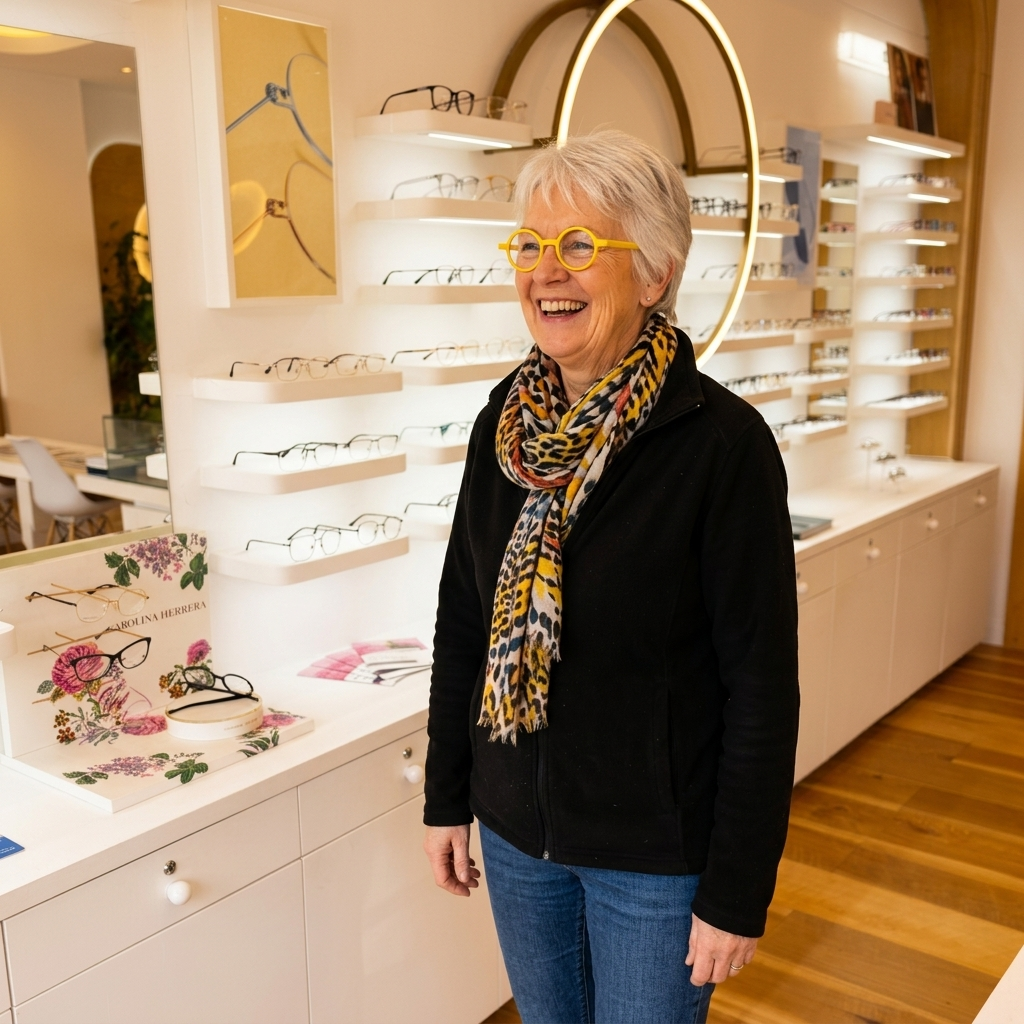
Clever contrast
Conventional guides would push her toward something more structured and neutral. Instead it's playful, bold, and completely right on her. Great example of colour and shape confidence overriding the generic advice.
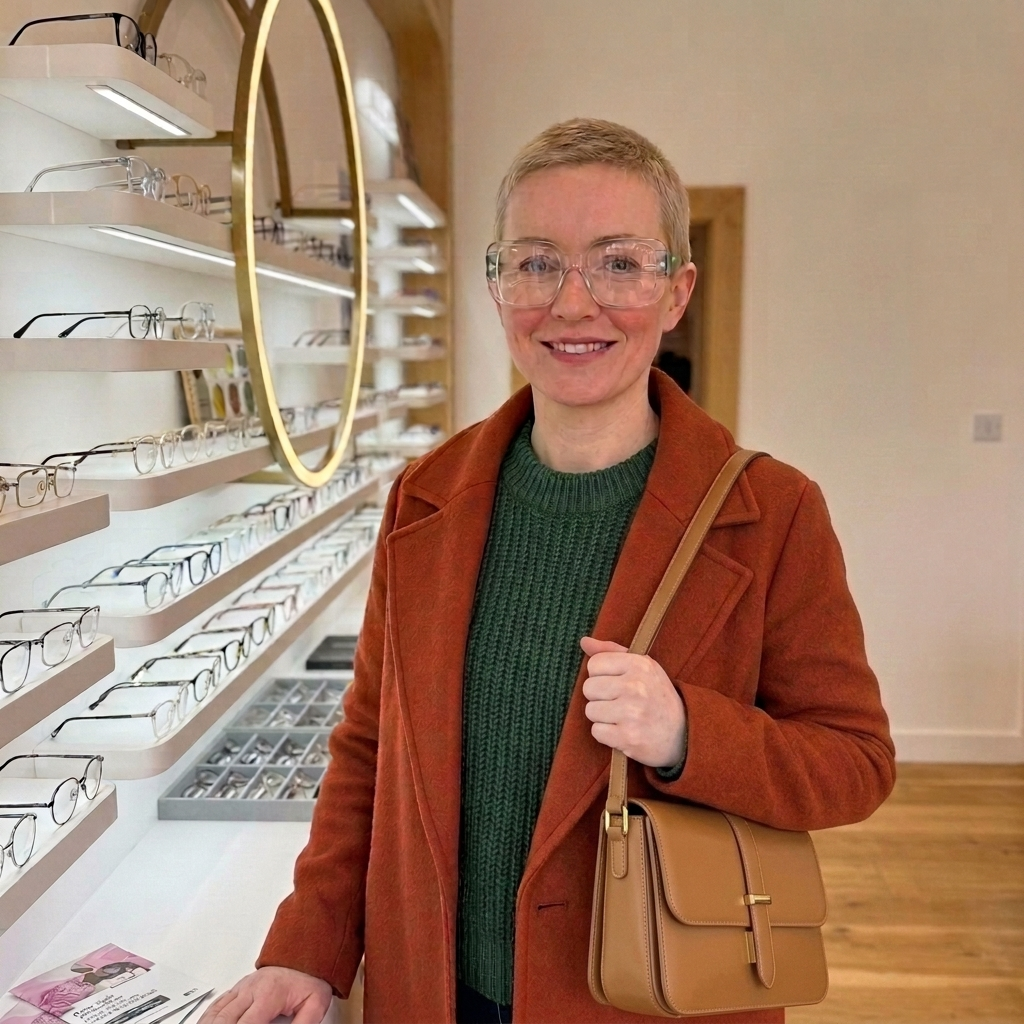
Make it stand out
Conventional guides would typically steer away from on that face shape. It works precisely because of the contrast principle — bold frame, strong face, confident result. Perfect for illustrating that the "rules" are limiting.
The Limitations of Online Try-On Tools
Virtual try-on technology has improved significantly, and for a general sense of how a frame sits on your face it's a reasonable starting point. But it has real limitations for anything beyond the most basic assessment.
It cannot account for how a frame actually sits — the angle, the nose bridge fit, the position of the lens relative to your pupil. It cannot reflect the weight of the frame or how it distributes across your ears and nose over several hours. And it cannot show you how the lenses will look once your prescription is glazed into the frame.
For everyday frames with a moderate prescription, online selection is increasingly viable if you know your PD, know your prescription, and understand what you're looking for. For varifocals, strong prescriptions, or your primary pair of glasses, an in-person fitting with an experienced dispensing optician is still the clearest route to a result you'll actually wear comfortably every day.
What to Expect From a Frame Consultation at Eddie Coyle Optometrists
When you come in for a frame fitting, we're not simply handing you styles to try. We're looking at where the frame sits relative to your pupil, how the bridge fits your nose, whether the temple length is correct, and how the frame interacts with your prescription. For stronger prescriptions we'll run the lens thickness calculations in different frame sizes so you can make an informed decision before you commit.
It takes longer than picking something off a shelf. It produces a result you'll be happy with for the next two years.
Both our Dennistoun and Cambuslang practices offer frame consultations as part of any dispensing appointment. If you'd like advice before committing to a frame — or you're not sure where to start — come in and we'll take it from there.
Eddie Coyle is a GOC-registered optometrist and founder of Eddie Coyle Optometrists, with practices in Dennistoun and Cambuslang, Glasgow.